



By ALLRESIST GmbH
Supplier Info
Product Type:
Parts & Consumables
Application:
Chemicals & Photoresists, Developer
Product Description:
The Allresist AR 300-26 and AR 300-35 are high-resolution positive photoresists designed for advanced semiconductor, MEMS, and micro-/nanofabrication applications. Both resists provide excellent sensitivity, high contrast, and reproducible performance, enabling the creation of submicron features with sharp line edges and uniform coating.
Characterisation:
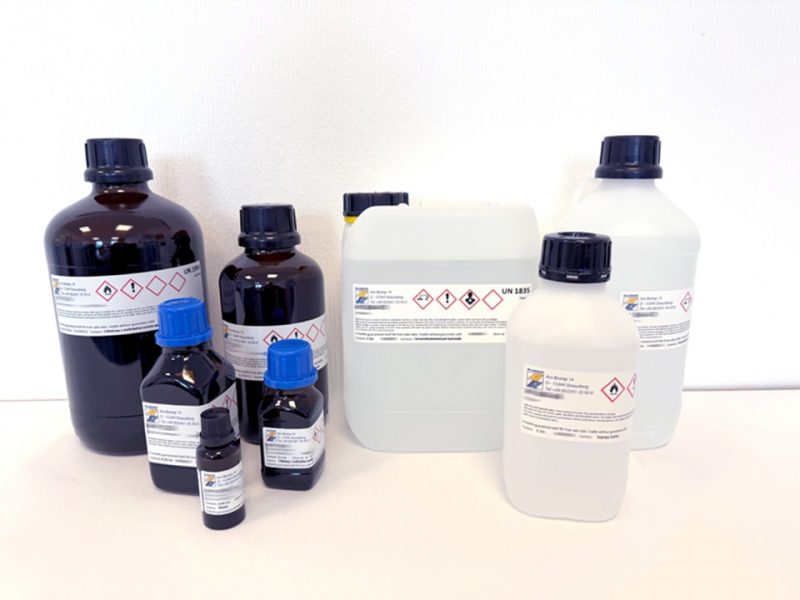
- buffered, colourless aqueous-alkaline solutions for photoresist development with low dark erosion
- AR 300-26 high contrast, steep edges, fast development, particularly suited for thick films
- AR 300-35 universal, wide process range for layers up to 6 µm
AR 300-26 Properties:
- Normality: 1.10 (n)
- Density at 20 °C: 1.06 g/cm3
- Filtration: 0.2 µm
- Storage 6 month: 10-22 °C
AR 300-35 Properties:
- Normality: 0.33 (n)
- Density at 20 °C: 1.02 g/cm3
- Filtration: 0.2 µm
- Storage 6 month: 10-22 °C
Available to order in pack sizes:
- 2.5L
- 5L
Pricing available on request.
There are currently no videos available.
Information on developer processing (applies to buffered developer and TMAH developers)
Higher developer concentrations result in a formally higher light-sensitivity of the resist-developer system, thus minimising the required exposure intensity, reducing the development times and allowing for a high throughput in production. It must however be taken into account that an increased dark erosion is associated with stronger developers which successively attacks unexposed structures. More diluted developers provide, depending on the kind of resist, higher contrast and reduce the thickness loss in unexposed or only partly exposed interface areas even with longer development times. This particularly selective working method ensures a high degree of detail reproduction, while the intensity required for exposure is inevitably increased at the same time. To obtain a high contrast, more diluted developer and longer development times are recommended. Substrates have to be rinsed in deionised water immediately after development until complete removal of all residual developer, and are subsequently dried.