



By ALLRESIST GmbH
Supplier Info
Product Type:
Parts & Consumables
Application:
Chemicals & Photoresists
Product Description:
The Allresist Protective Coating AR-PC 5040 is a high-performance protective coating designed to safeguard patterned structures during semiconductor, MEMS, and micro-/nanofabrication processes. It provides excellent chemical resistance and mechanical stability, making it ideal for use in aggressive wet processing and etching environments where sensitive layers require temporary protection.
Characterisation
- not light-sensitive > 300 nm, no yellow light required
- protection of wafer backside when etching the front side
- offers reliable protection against mechanical damage during handling and transport
- temperature-stable up to 250°C
- PMMA with different molecular weights, 503 in addition dyed dark
- solvent anisole
AR-PC 5040 Properties:
- Solids content: 17%
- Viscosity 25 °C: 550 mPas
- Film thickness/4.000 rpm: 2.8 µm
- Flash Point: 42 °C
- Storage temperature: 10-25 °C
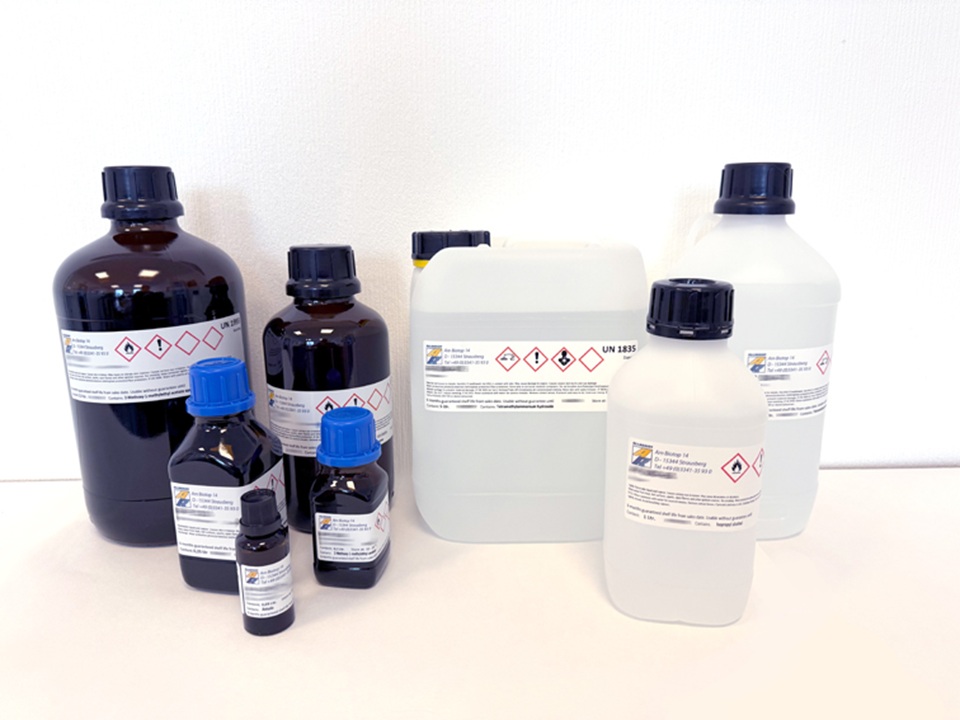
Available to order in pack sizes:
- 100 ml
- 250 ml
- 1L
Pricing available on request.
There are currently no videos available.
Processing instructions
Pre-treatment prior to coating: The protective effect during etching can be extended to up to 8 hours if the surface is pre-treated with adhesion promoter AR 300-80 new. The coating is preferably performed at 4000 rpm. After tempering at 180 °C for 2 min (hot plate), a uniform, 15 nm thin layer of adhesion promoter is formed (-> Product information AR 300-80 new).
Coating: A rotational speed of 1000 rpm is recommended for protective coatings, since at a film thickness of 2 – 5 µm wafer edges are best protected due to a certain “edge wrapping” of the resist. At higher spin speeds or if 6-inch wafers and above are used, the relatively high amount of resist which is deposited on the wafer may cause the so-called candy-floss effect. Low spin speeds, local exhaustion or removal of the “candy floss” with a glass rod during coating reduces these highly disturbing effects.
Tempering: To obtain a particularly high protective effect for the fabrication of hard-baked films, tempering temperatures of 190 °C are recommended.
Etch process: The protective coating is even after hours not attacked by 40 % KOH. Possibly occurring problems only derive from insufficient adhesive strength and can be significantly reduced with a pre-treatment with AR 300-80 new.